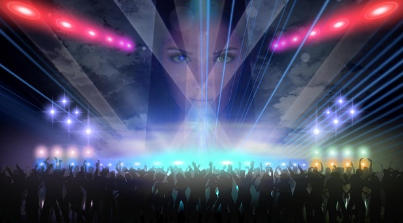
The core of a laser light is the laser generator, whose working principle is based on “Light Amplification by Stimulated Emission of Radiation” (LASER). Simply put, an excitation source (such as electric current or optical pump) is used to excite the laser medium (solid, gas, semiconductor, etc.), making the atoms in the medium absorb energy and jump to a high energy level. When a large number of high-energy level atoms gather and are stimulated by the outside world, they will synchronously release photons with completely consistent frequency, phase and propagation direction, forming a highly concentrated laser with extremely strong monochromaticity. Different from ordinary lights, lase r has a very small beam divergence angle, which can achieve long-distance precise projection, and its brightness is much higher than that of traditional lights with the same power. Laser lights focus through lenses, guide through reflectors, and then adjust the intensity, color and shape of the beam with a control system to finally present various light and shadow effects we see, which are widely used in stages, outdoors, scientific research and many other fields. Understanding this principle can help us better distinguish the essential differences between laser lights and ordinary lights and understand their unique light and shadow advantages.
r has a very small beam divergence angle, which can achieve long-distance precise projection, and its brightness is much higher than that of traditional lights with the same power. Laser lights focus through lenses, guide through reflectors, and then adjust the intensity, color and shape of the beam with a control system to finally present various light and shadow effects we see, which are widely used in stages, outdoors, scientific research and many other fields. Understanding this principle can help us better distinguish the essential differences between laser lights and ordinary lights and understand their unique light and shadow advantages.