Confronting the “Irreversible Loss” of Chemically Treated Hair
The sustained boom in hair coloring conceals a long-overlooked truth:chemical damage to the hair shaft is irreversible. Bleaching agents sever disulfide bonds while hollowing out the cortical layer; thermal setting locks in new shapes at the expense of premature keratin denaturation. Each attempt to “refresh the color” or “switch up the curl pattern” draws down the finite lifespan of the strand. Recently, French skincare house SACELLEC BEAUTE launched its hair oil, declining to mask this reality with promises of “restoring hair to its virgin state.” Instead, the brand confronts the chemically treated hair predicament head-on, offering a sustainable maintenance protocol for compromised hair fibers
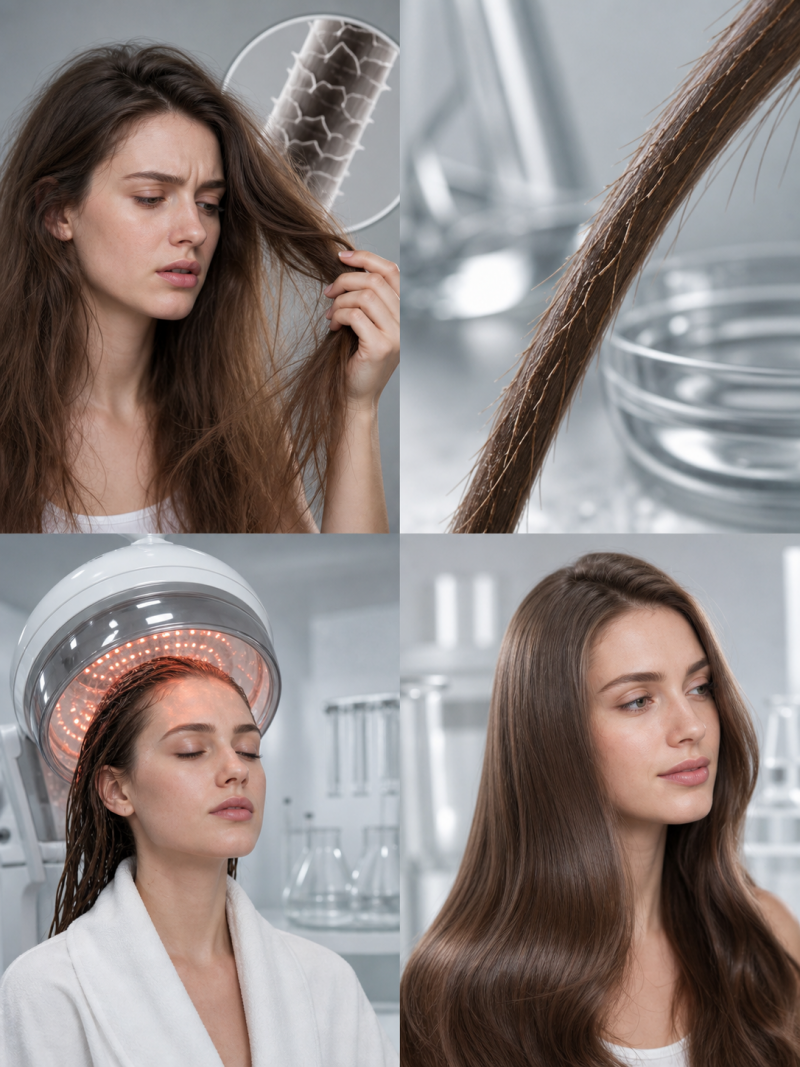
The challenges facing this demographic share a remarkably consistent pathology. Post-bleach porosity disrupts the hair’s hydroregulation capacity—cuticles imbibe water during washing, then desiccate upon drying, cycling through repetitive swelling and contraction that permanently lift the cuticle scales. The manifestations are tactile and audible:Wet hair coils into algal tangles around the fingers; dry hair resembles dandelions caught in static cling; a hand gliding through the strands elicits a faint, rasping friction. More critically, thermally compromised hair exhibits hypersensitivity to heat. Medium dryer settings can fuse brittle ends into intractable knots, while air-drying yields heavy, collapsed hair strands that cling to the cheeks.
Conventional haircare responses address symptoms rather than the root etiology. Silicone-based formulations deposit a hydrophobic occlusive film that temporarily smooths the cuticle, but cumulative scalp buildup disrupts sebum balance while the distal segments remain parched. Protein-infusion products attempt intrafibrillar repair, yet macromolecular weights preclude meaningful penetration; the actives remain confined to the surface, forming a rigid cast that feels glutinous to the touch. Both approaches share a flawed premise: that damaged hair must be retrofitted to some idealized baseline. They overlook the actual priority of the chemically treated consumer—hair’s condition is irreversible, and the core priority is to maintain its daily manageability.
SACELLEC BEAUTE’s formulation logic begins with an admission of constraint. The seven botanical lipids do not construct an illusion of “repair”; they perform discrete, necessary functions to sustain basic fiber integrity. Argania spinosa kernel oil and macadamia seed oil reduce the coefficient of friction, enabling detangling implements to traverse from proximal to distal without fracturing the weakened midshaft. Persea gratissima oil and Elaeis guineensis oil form a pliant lipid mantle over the cortex, moderating hydration flux kinetics and stabilizing cuticular fluctuation. Oenothera biennis oil, carrying γ-linolenic acid, participates in intercellular lipid reorganization within the cuticle, partially restoring elastic memory. Prunus amygdalus dulcis oil and Butyrospermum parkii butter create a dynamic terminal barrier that retards the longitudinal spread of split ends.The inclusion of squalane ensures biomimetic compatibility with endogenous sebaceous lipids, preventing exogenous occlusion from compounding metabolic burden.
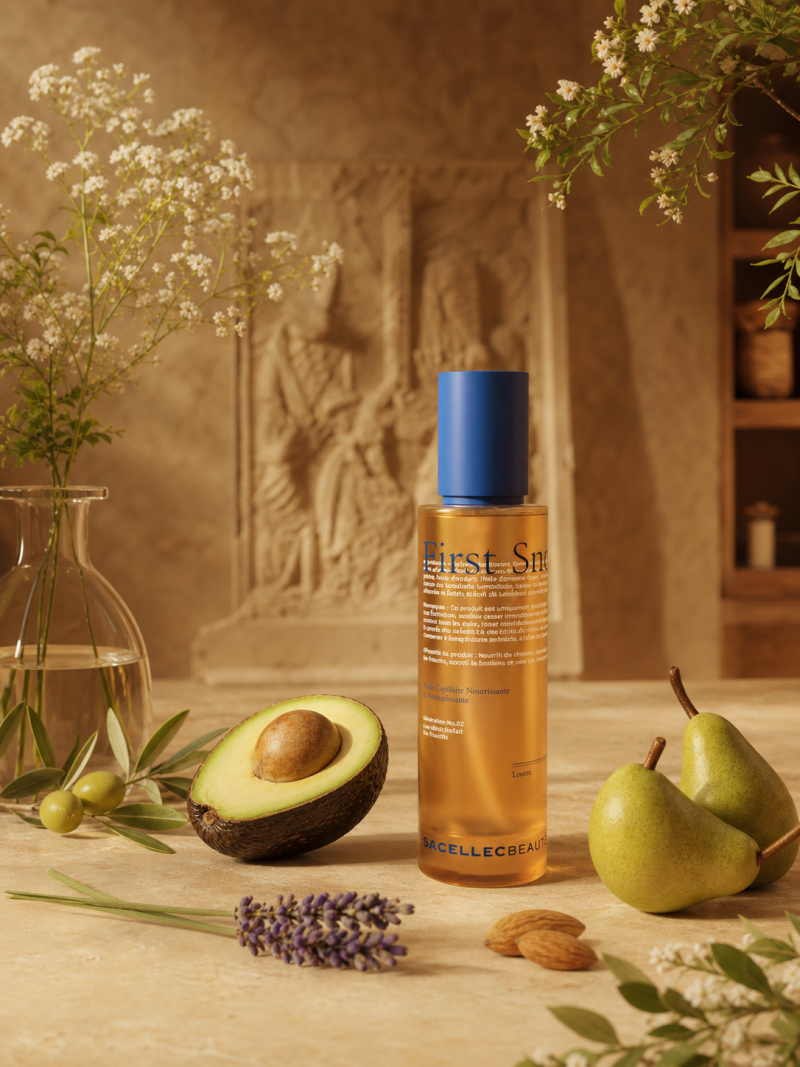
The textural experience of the product is targeted and optimized for the physical properties of heat-damaged and color-treated hair. Elevated specific surface area in bleached hair means adsorptive capacity for lipids scales disproportionately. Excessively dense oil matrices would oversaturate the hair fiber surface
, collapsing root volume, obliterating curl definition, and flattening architectural intent. SACELLEC BEAUTE employs a low-viscosity, lightweight carrier system characterized by reduced molecular footprint and rapid spreading kinetics. The result is a monomolecular film rather than multilayer accretion—delivering lubrication and protection without altering native buoyancy or silhouette. Applied to damp hair, it functions as a thermal protectant, mitigating keratin denaturation from blow-drying; on dry styled hair, it suppresses cuticular frizzing without disrupting the day’s coiffure.
The olfactory dimension addresses an overlooked sensitivity. Post-bleach porosity transforms hair into a persistent aroma substrate; inferior fragrances can linger for days or weeks. For consumers who wear personal fragrance as part of their identity, a haircare scent must not compete for olfactory space. SACELLEC BEAUTE follows a “non-intrusive” olfactory principle: top notes of citrus and green fruit volatilize within ten minutes post-application; the heart transitions to near-imperceptible white florals; the dry-down recedes to virtual silence. This restraint ensures the user’s chosen perfume remains the primary olfactory narrator.
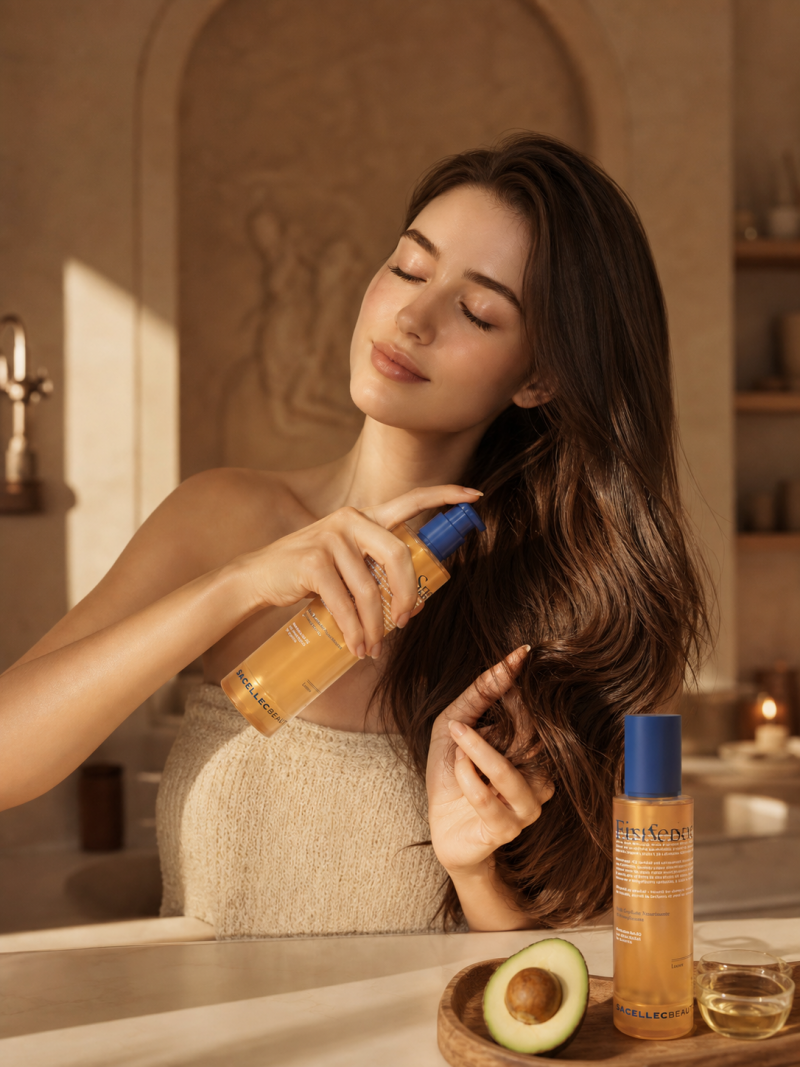
Usage protocol simplification reflects respect for the temporal constraints of the target demographic. Salon intervals typically span six to eight weeks, during which fiber degradation progresses unchecked. Most restorative regimens demand two to three intensive sessions weekly to register measurable improvement. SACELLEC BEAUTE embeds application within existing routines: post-cleansing, pre-drying to preempt thermal insult; post-styling to sustain diurnal presentation. No dedicated time blocks or behavioral adjustments are required. Shift hair care from a deliberate chore to an organic part of daily life.
The brand’s candor in efficacy communication stands in stark contrast to industry norms. Product documentation contains no references to “reversing damage” or “rebuilding strength.” Instead, it states plainly: this is a maintenance product for chemically altered fiber, designed to preserve manageability throughout the residual hair lifecycle rather than reconstitute severed keratin chains. This biology-grounded framing resonates with a consumer base that has cycled through enough hyperbolic claims to recognize a tool that does not lie.
From a industry perspective, SACELLEC BEAUTE’s entry signals a maturation pivot—from broad-spectrum “repair” narratives toward precision management of specific damage etiologies. Chemically treated hair constitutes a demographically stable, causally defined, and underserved segment with determinable disease progression. A product that acknowledges irreversibility, slows deterioration, and preserves daily functionality fills a structural gap.
For the chemically treated consumer, accepting irreversibility is not a surrender of aesthetic autonomy. On the contrary, rational maintenance within acknowledged limitations is the purest expression of control. SACELLEC BEAUTE does not promise to make damaged hair “better.” It promises something more honest: that compromised hair can still uphold a person’s image of themselves—detanglable, styleable, presentable, viable until the next salon appointment. This pragmatic stance, free of manufactured anxiety and decorative denial, may well define the professional substratum of prestige haircare.